住酒店不用“刷脸”了?上海明确住宿登记流程,严禁不“刷脸”不能入住 ——秒词邦背单词app

在酒店办理入住登记时,很多旅客都已习惯了“刷脸”办理入住,甚至可以将其视为数字社会带来的便捷体验。但是也有人担心,人脸信息过多被采集真的安全吗?酒店“强制刷脸”是否合理,真有必要吗?
4月19日,澎湃新闻(www.thepaper.cn)记者注意到,近期在上海市旅馆业治安管理信息系统中相继有通知和提示发布,严禁对已出示本人有效身份证件的旅客进行“强制刷脸”核验,严禁发生不“刷脸”不能入住问题。
官网系统:严禁“强制刷脸”,忘带身份证件刷脸须征得同意
在上海市旅馆业治安管理信息系统的系统公告栏可以看到,4月7日上海市公安局出入境管理局发布《关于发布旅客住宿有效身份证件和住宿登记问询流程的通知》。其中提到,上海市公安局治安总队、出入境管理局制作了《旅客住宿有效身份证件须知》《旅客住宿登记问询流程图》。
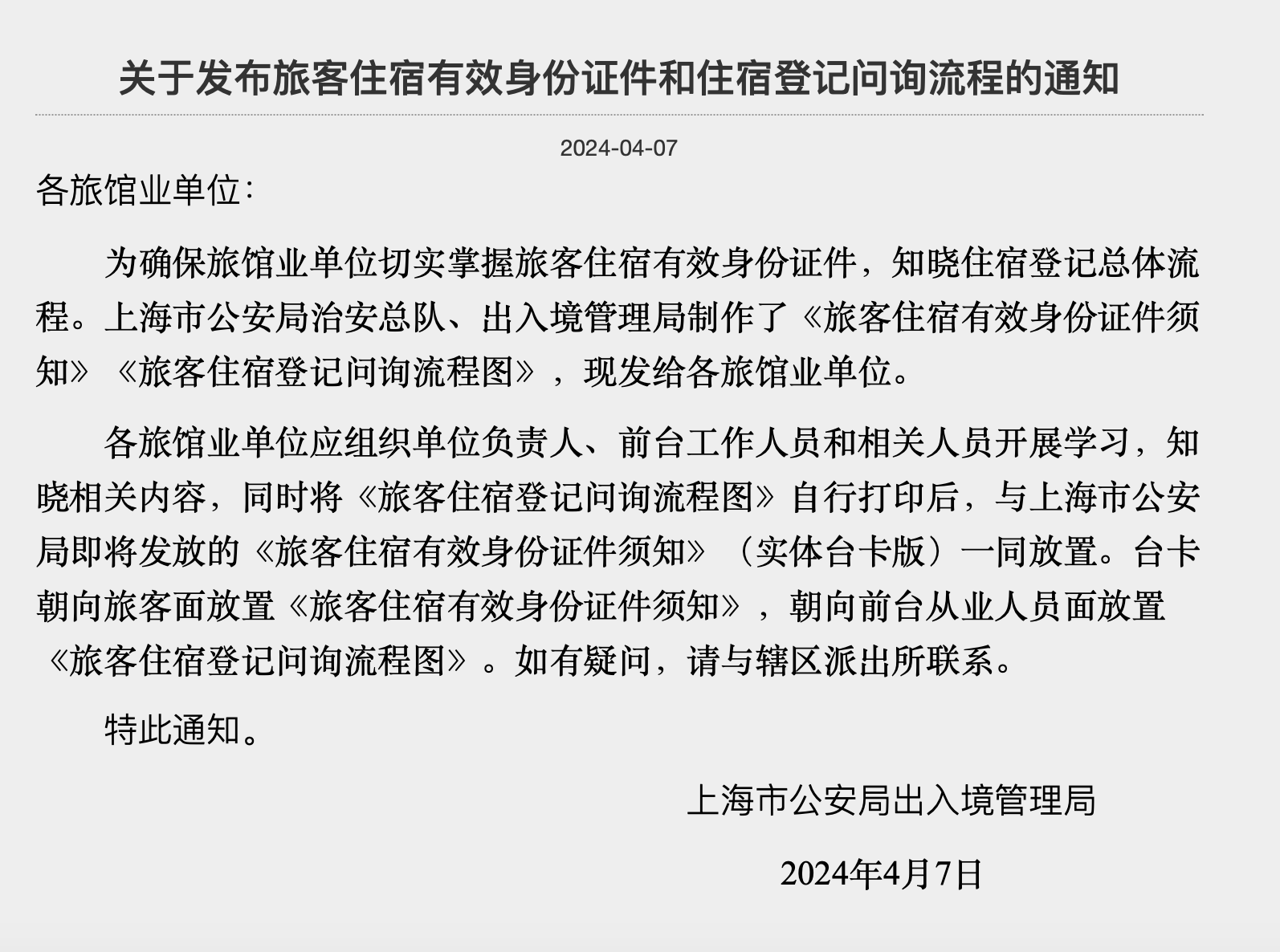
上海市旅馆业治安管理信息系统公告 网页截图

旅客住宿登记问询流程图,其中关于人脸信息采集分为同意与不同意。
流程图显示,对于无有效身份证件的到店大陆内地居民,可采用两种方式进行身份核验,“刷脸”须征得同意。如旅客同意采集人脸信息,则进入“未带身份证登记”模块进行办理;如旅客不同意采集人脸信息,则请旅客到派出所开具相关证明。

旅客住宿有效身份证件须知
而根据《旅客住宿有效身份证件须知》,上述“有效身份证件”对于中国大陆内地旅客来说包括身份证(包括临时身份证)、警官证、护照、驾驶证、社保卡、居住证、中华人民共和国旅行证(出生地为非香港、澳门、台湾)、中华人民共和国出入境通行证、以及军官证和士兵证等。
通知中还要求,应在酒店前台朝向旅客面放置《旅客住宿有效身份证件须知》,朝向前台从业人员面放置《旅客住宿登记问询流程图》。
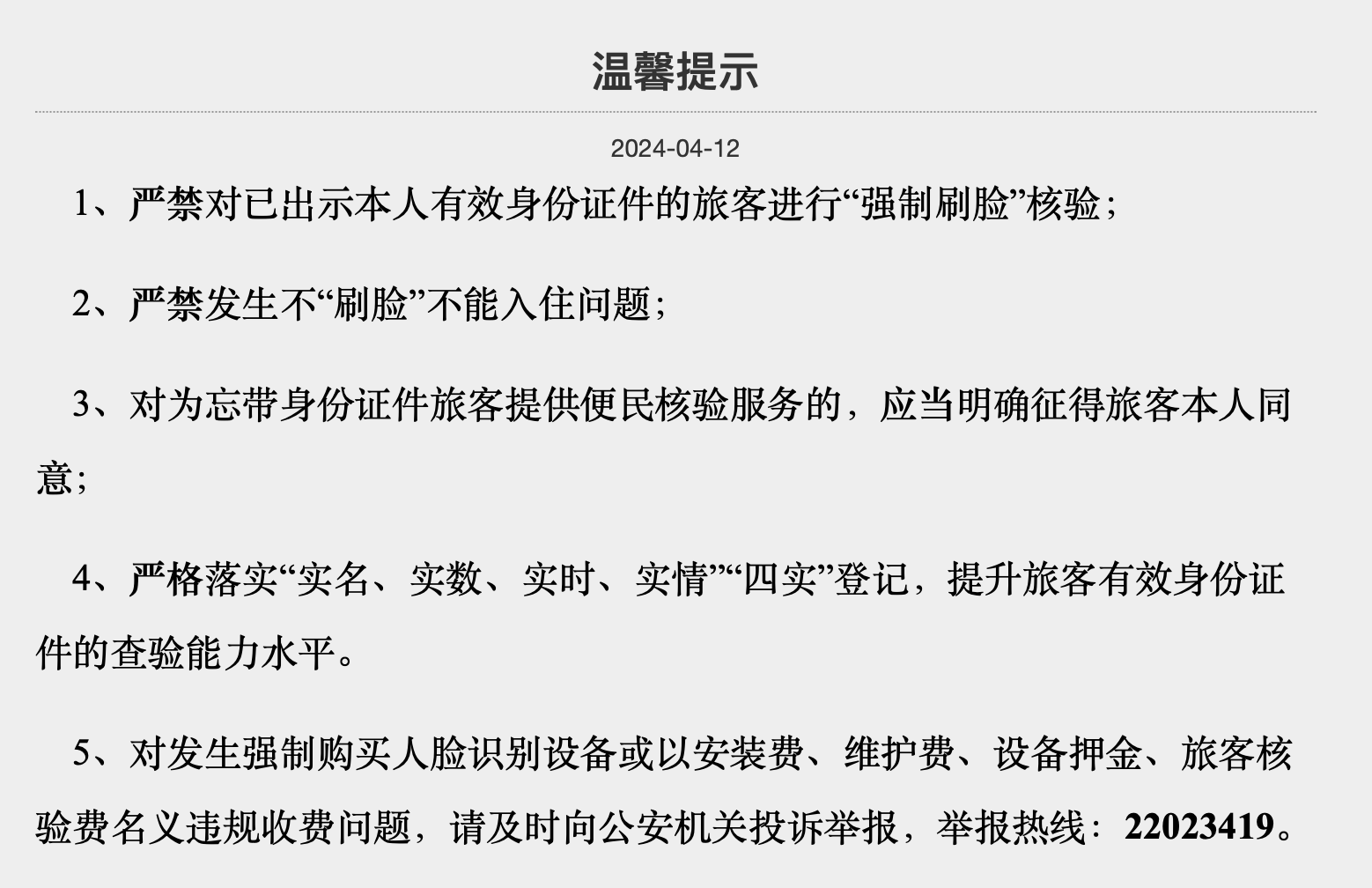
上海市旅馆业治安管理信息系统内发布的温馨提示,其中严禁“强制刷脸” 网页截图
此外,4月12日,系统内再次发布一则温馨提示,其中明确表示:严禁对已出示本人有效身份证件的旅客进行“强制刷脸”核验;严禁发生不“刷脸”不能入住问题;对为忘带身份证件旅客提供便民核验服务的,应当明确征得旅客本人同意。
酒店前台:根据属地派出所要求,不再强制要求刷脸
19日下午,澎湃新闻记者致电上海各区十余家酒店,前台均表示目前没有“强制刷脸”要求。有的酒店称自去年起就不再“强制刷脸”,更多酒店则表示近期信息系统升级,且根据属地派出所的要求,已不再有“强制刷脸”要求。新要求执行的时间方面,有的表示从3月开始,也有前台表示是自本月起或已有两三周。
对于近期系统升级的说法,记者也在上海市旅馆业治安管理信息系统上看到一则发布于3月22日的《关于旅业系统升级的通知》,但通知中并未提及升级是否调整了对于人脸信息的要求。
在旅客携带居民身份证的情况下,各家酒店均表示可以直接办理入住。如未带身份证,电子身份证、身份证照片、驾驶证、社保卡等也均可以用于办理入住。“只要能够用于核对个人身份信息就可以。”一位酒店前台说。
而对于新要求推行的范围,酒店多数表示是接属地派出所的通知,而即使是连锁酒店,也有前台表示并不确定上海地区是否所有同品牌酒店要求都一致。
全国政协委员:应限制过度使用“人脸识别”
酒店采集人脸信息是否有法可依?人脸信息的采集是否过于泛滥?此前在今年3月的全国两会期间,全国政协委员、中国旅游研究院院长戴斌就曾提交《关于限制旅游场景过度使用“人脸识别”的提案》。
戴斌通过调研发现,几乎所有省市的宾馆、酒店、民宿等旅游住宿机构都设置了人脸识别系统,游客除了要出示并由接待人员查验身份证件,还要到专门的人脸识别设备前“刷脸”才能入住。
进一步调研指出,在酒店加装人脸识别设备终端,既没有明确的法律和行政法规规定,也没有正式成文的部门规章规定。现在让游客做人脸识别的地方都是按照“告知且同意”的原则实施的,即公安部门告知旅馆、酒店、民宿,然后旅馆、酒店、民宿也同意做,所以就做了。
针对“人脸识别”的过度使用,戴斌建议公安部对强制酒店、度假村、民宿等旅游住宿机构购买和使用人脸识别终端的情况全面摸底排查,及时指导各地公安部门取消游客入住宾馆酒店必须“刷脸”的规定,并召回相关的软硬件设备。
此外,提案还建议国家网信办尽快实施《人脸识别技术应用安全管理规定》,并加强对征求意见稿第九条的监督检查。该条明确要求“宾馆、银行、车站、机场、体育场馆、展览馆、博物馆、美术馆、图书馆等经营场所,除法律、行政法规规定应当使用人脸识别技术验证个人身份的,不得以办理业务、提升服务质量等为由强制、误导、欺诈、胁迫个人接受人脸识别技术验证个人身份”。对“告知且同意”等涉嫌侵权的变通做法做出明确提示并做出整改要求。
新闻译文:
When checking in at hotels, many travelers have become accustomed to "brushing their faces" to check in, and can even see it as a convenient experience brought by the digital society. But some people are also worried, is it really safe to collect too much facial information? Is it reasonable and necessary for hotels to forcibly brush their faces?
On April 19th, a reporter from The Paper (www.thepaper. cn) noticed that there have been notices and reminders recently released in the Shanghai hotel industry security management information system, prohibiting passengers who have presented their valid identification documents from being subjected to "mandatory facial recognition" verification, and prohibiting the occurrence of non facial recognition and inability to stay.
Official website system: It is strictly prohibited to "force facial recognition". Forgetting to bring identification documents for facial recognition requires consent
On April 7th, the Shanghai Public Security Bureau Exit Entry Management Bureau issued a notice on the system announcement board of the Shanghai Hotel Public Security Management Information System regarding the issuance of valid identification documents and accommodation registration inquiry processes for passengers. It is mentioned that the Public Security Brigade of Shanghai Public Security Bureau and the Exit Entry Management Bureau have developed the "Notice on effective Identity Documents for Passengers' Accommodation" and the "Inquiry process Diagram for passenger Accommodation Registration".
Screenshot of the announcement webpage of the Shanghai Hotel Public Security Management Information System
Passenger accommodation registration inquiry process diagram, where facial information collection is divided into agree and disagree.
The flowchart shows that for mainland Chinese residents who do not have valid identification documents, two methods can be used for identity verification, and consent must be obtained for facial recognition. If the passenger agrees to collect facial information, they will enter the "Registration without ID Card" module for processing; If the passenger does not agree to collect facial information, please go to the police station to issue relevant certificates.
Notice on valid identification documents for passenger accommodation
According to the Notice on Valid Identity Documents for Accommodation of Passengers, the above-mentioned "valid identity documents" include identity cards (including temporary identity cards), police officer cards, passports, driver's licenses, social security cards, residence cards, travel cards of the People's Republic of China (born in places other than Hong Kong, Macao and Taiwan), entry and exit passes of the People's Republic of China, military officers' cards and soldiers' cards for mainland Chinese Mainland passengers.
The notice also requires that the "Notice on Valid Identity Documents for Guests Accommodation" should be placed at the front desk of the hotel facing passengers, and the "Passenger Accommodation Registration Inquiry Process Diagram" should be placed at the front desk facing staff.
A warm reminder posted in the Shanghai Hotel Industry Public Security Management Information System, which prohibits "mandatory facial recognition" webpage screenshots
In addition, on April 12th, a warm reminder was once again released in the system, which clearly stated that it is strictly prohibited to conduct "mandatory facial recognition" verification on passengers who have presented their valid identification documents; It is strictly prohibited to have the problem of not being able to move in without facial recognition; For passengers who forget to bring their identification documents and provide convenient verification services, their consent should be clearly obtained.
Hotel front desk: according to the requirements of the local police station, facial recognition is no longer mandatory
On the afternoon of the 19th, a reporter from Pengpai News called more than ten hotels in various districts of Shanghai, and the front desk stated that there is currently no requirement for mandatory facial recognition. Some hotels claim that they have stopped "mandatory facial recognition" since last year, while more hotels indicate that their information systems have recently been upgraded and that according to the requirements of local police stations, there are no longer "mandatory facial recognition" requirements. In terms of the implementation time of the new requirements, some have indicated that it will start from March, while others have indicated that it will start from this month or have been two to three weeks.
Regarding the recent system upgrade, the reporter also saw a notice on the hotel industry security management information system in Shanghai, which was released on March 22. However, the notice did not mention whether the upgrade adjusted the requirements for facial information.
When passengers carry their resident ID cards, all hotels indicate that they can check-in directly. If you do not bring your ID card, electronic ID card, ID card photo, driver's license, social security card, etc. can also be used for check-in. "As long as it can be used to verify personal identity information," said a hotel front desk.
For the scope of the new requirements, most hotels indicate that they are receiving notifications from local police stations, and even chain hotels have front desk representatives who express uncertainty about whether all hotels of the same brand in Shanghai have the same requirements.
Members of the National Committee of the Chinese People's Political Consultative Conference: Excessive use of "facial recognition" should be restricted
Is there a legal basis for hotels to collect facial information? Is the collection of facial information too extensive? Previously, during the National People's Congress and Chinese People's Political Consultative Conference in March this year, Dai Bin, a member of the National Committee of the Chinese People's Political Consultative Conference and president of the China Tourism Research Institute, submitted a proposal to restrict the excessive use of facial recognition in tourism scenes.
Dai Bin found through research that almost all hotels, guesthouses, homestays and other tourism accommodation institutions in provinces and cities have set up facial recognition systems. Tourists not only need to present and have their identification documents checked by reception personnel, but also need to go to specialized facial recognition devices to "brush their faces" before they can check in.
Further research indicates that there are no clear laws and administrative regulations, nor formal departmental rules and regulations for installing facial recognition device terminals in hotels. Nowadays, places where tourists are asked to do facial recognition are implemented according to the principle of "inform and agree", that is, the public security department informs hotels, hotels, and homestays, and then hotels, hotels, and homestays also agree to do it, so it is done.
In response to the excessive use of facial recognition, Dai Bin suggests that the Ministry of Public Security conduct a comprehensive investigation into the forced purchase and use of facial recognition terminals by tourism accommodation institutions such as hotels, resorts, and homestays, and promptly guide local public security departments to cancel the requirement for tourists to "brush their faces" when staying in hotels and recall relevant software and hardware equipment.
In addition, the proposal also suggests that the National Cyberspace Administration implement the "Regulations on the Security Management of Facial Recognition Technology Applications" as soon as possible, and strengthen the supervision and inspection of Article 9 of the draft for soliciting opinions. This article clearly requires that "hotels, banks, stations, airports, sports venues, exhibition halls, museums, art galleries, libraries and other business premises, except for those that are required by laws and administrative regulations to use facial recognition technology to verify personal identity, shall not force, mislead, deceive, or coerce individuals to accept facial recognition technology to verify personal identity on the grounds of handling business or improving service quality.". Provide clear reminders and rectification requirements for alternative practices suspected of infringement, such as "informing and agreeing".
重点词汇
有必要 be necessary ; need ; indicate ; oblige ; have occasion to
澎湃 surge ; be in an upsurge ; the roaring of breakers
注意到 have noticed ; have paid attention ; give heed to ; perceive ; notice ; observe ; alert ; conscious ; spot ; feel ; register ; cop ; clock
上海市 Shanghai ; Shanghai Municipality ; Shanghai City
旅馆业治安管理 administration of public order at hotels
信息系统 information system
严禁 strictly prohibit(forbid) ; strictly forbid
身份证件 identity document
核验 verification
旅馆业 the hotel industry
句子成分分析:
Further research indicates | that there are no clear laws and administrative regulations, nor formal departmental
rules and regulations [for installing facial recognition device terminals in hotels].
句子语法结构详解:
* indicates 为谓语,采用一般现在时。动词采用第三人称单数形式。
* that 为连词,引导宾语从句。
* there 引导 there be ... 句型, 表示“有”的意思。
* are 为系动词作谓语,采用一般现在时。
* installing 为动名词,作介词宾语。
句子相关词汇解释:
Vocabulary:
| further ['fә:ðә] | a. | 1) 进一步的 2) (far 的比较级) 更远的,较远的 |
| research [ri'sә:tʃ] | n. | 研究,调查,探索 |
| indicate ['indikeit] | vt. | 1) 表明,显示 2) 象征,暗示 |
| clear [kliә] | a. | 1) 清楚的,明白的,无疑的 2) 清晰易懂的,明白清楚的,不含混的 3) 明显的,显然的,明确的 4) 透明的,清澈的 |
| law [lɔ:] | n. | 1) 法律,法规 2) 原理,定律 |
| and [ænd] | conj. | 1) 和, 与, 同, 并 2) 然后,接着 |
| administrative [әd'ministrәtiv] | a. | 管理的,行政的 |
| regulation [,regju'leiʃәn] | n. | 1) 章程,规章制度,规则,法规 2) (运用规则条例的)管理,控制 |
| nor [nɔ:] | conj. | 也不, 也没 |
| formal ['fɔ:mәl] | a. | 1) 正式的,合乎规矩的 2) (服式、言语、书写、行为等)适合正式场合的,正规的,庄重的 |
| departmental [,di:pɑ:t'mentәl] | a. | 部门的;分部的 |
| rule [ru:l] | n. | 1) 规则,规章,条例 2) 建议,应做之事 |
| install [in'stɔ:l] | vt. | 1) 安装,设置 2) (常以正式仪式)使就职,任命 |
| facial ['feiʃәl] | a. | 面部的 |
| recognition [,rekәg'niʃәn] | n. | 1) 承认,认可 2) 认出,认识,识别 |
| device [di'vais] | n. | 1) 装置,设备,仪器 2) 手段,策略 |
| terminal ['tә:minәl] | n. | 1) 终端,终端机 2) 航空站,航空终点站 |
| hotel [hәu'tel] | n. | 旅馆,饭店 |
句子成分分析:
Provide clear reminders and rectification requirements for alternative practices suspected of infringement,
such as "informing and agreeing".
句子语法结构详解:
* 本句为祈使句。
* provide 为谓语。
* suspected 为过去分词,作后置定语。
* informing 为动名词,作介词宾语。
* agreeing 为动名词。
句子相关词汇解释:
Phrase:
| such as | 1) 例如,比如 2) 像……那样的,诸如……之类的 |
Vocabulary:
| provide [prә'vaid] | vt. | 1) 提供,供应,给予 2) 规定 |
| clear [kliә] | a. | 1) 清楚的,明白的,无疑的 2) 清晰易懂的,明白清楚的,不含混的 3) 明显的,显然的,明确的 4) 透明的,清澈的 |
| reminder [ri'maindә] | n. | 1) 引起回忆的事物, 提醒物 2) 通知(单), 提示(信) |
| and [ænd] | conj. | 1) 和, 与, 同, 并 2) 然后,接着 |
| rectification [,rektifi'keiʃәn] | n. | 改正, 矫正, 整流 |
| requirement [ri'kwaiәmәnt] | n. | 1) 必要条件,必备的条件 2) (通常作 requirements)所需的(或所要的)东西 |
| alternative [ɔ:l'tә:nәtiv] | a. | 1) 可供替代的 2) 非传统的,另类的 |
| practice ['præktis] | n. | 1) 实践,实际行动 2) 惯例,常规,守则, (通常的)做法 |
| suspect [sә'spekt] | vt. | 1) 怀疑,感觉有问题,不信任 2) 疑有,觉得(尤指坏事可能属实或发生) |
| infringement | n. | 违犯, 侵害, 违反, 侵犯 |
| agree [ә'gri:] | vi. | 1) 同意,赞成 2) 答应, 应允 |
以上是秒词邦为您整理编写的文章《住酒店不用“刷脸”了?上海明确住宿登记流程,严禁不“刷脸”不能入住 ——秒词邦背单词app》的全部内容。秒词邦是国内权威分题型分考点背诵中高考/四六级考研/专升本/出国单词的专业单词软件。扫描如下小程序码,进入秒词邦官方小程序获取更多英语相关资料! 【关键词:高考单词;高考英语;高中单词;高中英语;单词app;单词软件;记单词app;记单词软件;背单词软件;背单词app;英语单词;四六级单词;四六级英语;四六级单词app;四六级单词软件;考研单词app;考研单词软件;核心单词;高考冲刺复习;高考英语教材;高考英语真题;四六级真题;四六级试题;考研真题;考研英语单词;考研英语真题】