太空碎片砸中民房,美国宇航局:确认是3年前国际空间站抛弃的废电池组 ——秒词邦背单词app

▲3月初砸中意大利民房的太空垃圾
4月15日,美国宇航局(NASA)确认上个月撞击佛罗里达州一所房屋的神秘物体是来自国际空间站(ISS)的一块太空垃圾。
当时,房主亚历杭德罗·奥特罗正在度假,在得知儿子差点被砸中后,他立即赶回家检查,发现这个圆柱形的太空垃圾砸穿了他家屋顶和地板,幸而没有人受伤。随后,这个圆柱形太空垃圾被送往佛罗里达州卡纳维拉尔角的肯尼迪航天中心进行分析。
经过佛罗里达州肯尼迪航天中心专家分析,美国宇航局官员4月15日发布声明,称这块圆柱形的太空垃圾是由一种名为铬镍铁的合金金属制成,重1.6磅(0.7公斤),高4英寸(10厘米),宽约1.6英寸(4厘米),是用来固定旧电池在货物托盘上的金属支架。
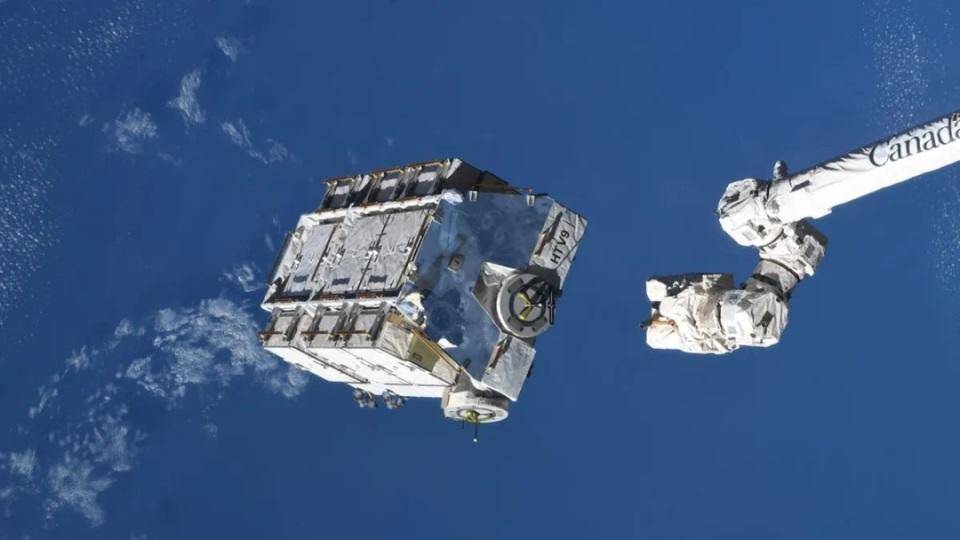
▲机械臂将废弃电池组抛向太空,这是有史以来从国际空间站丢弃的最大物体
据报道,这块金属残骸源自国际空间站废弃的电池组。早在2021年,这个重约2.9吨的电池组就从国际空间站被机械臂抛向太空,是有史以来从国际空间站丢弃的最大物体。原本预计这个电池组在重新进入地球大气层时将完全燃烧,不会留下任何残骸。然而,出乎意料的是,其中一块金属块经过三年的飞行,在大气层中幸存下来,砸中了民房。
电池升级是国际空间站近年来重要的维护工作之一。2017年至2020年的4次日本货运飞船HTV任务向其交付了24套锂离子电池,以取代48套老化的镍氢电池。按照惯例,一艘HTV送上去新电池,然后带着上一次任务换下来的旧电池离轨,再入大气层烧毁。
然而,2018年10月联盟号MS-10飞船的发射失败打乱了轮替,直到HTV飞船2020年退役,国际空间站上始终滞留了一批没能随飞船离轨的旧电池。
最后,2021年NASA决定在轨丢弃这些旧电池及其托盘。NASA当时说,EP9预计2到4年内重返大气层,它们通常会在地球大气层中安全地燃烧殆尽。
目前,美国航天局承诺会使用工程模型来估计物体在重返大气层过程中是如何升温和分解,详细调查这块碎片是如何在进入大气层时幸存下来,并将据此更新其工程模型。同时表示,他们致力于在低地球轨道上负责任地运作,并在必须释放太空硬件时尽量减少对地球上人们的风险。
被未燃尽金属块砸穿房屋的美国房主奥特罗表示,不知道谁来为他家损失买单。这起意外所引发的赔偿问题可能会较为复杂,因为虽然安装在托盘上的电池属于美国所有,但托盘本身则是由日本航空航天研究开发机构(JAXA)发射的。
红星新闻记者 范旭 实习生 黄金
编辑 潘莉 责编 冯玲玲
新闻译文:
Space debris that hit Italian houses in early March
On April 15th, NASA confirmed that the mysterious object that collided with a house in Florida last month was a piece of space debris from the International Space station (ISS).
At that time, the homeowner Alejandro Otro was on vacation. Upon learning that his son had almost been hit, he immediately rushed home to inspect and found that the cylindrical space debris had penetrated his roof and floor. Fortunately, no one was injured. Subsequently, the cylindrical space debris was sent to the Kennedy Space center in Cape Canaveral, Florida for analysis.
After analysis by experts from the Kennedy Space Center in Florida, NASA officials issued a statement on April 15th stating that this cylindrical space debris is made of an alloy metal called chromium nickel iron. It weighs 1.6 pounds (0.7 kilograms), is 4 inches (10 centimeters) tall, and is approximately 1.6 inches (4 centimeters) wide. It is a metal bracket used to secure old batteries on cargo pallets.
▲ The robotic arm throws discarded battery packs into space, which is the largest object ever discarded from the International Space Station
According to reports, this metal wreckage originated from an abandoned battery pack on the International Space Station. As early as 2021, this approximately 2.9 ton battery pack was thrown into space by a robotic arm from the International Space Station, making it the largest object ever discarded from the station. It was originally expected that this battery pack would completely burn without leaving any debris upon re-entering the Earth's atmosphere. However, unexpectedly, one of the metal blocks survived three years of flight in the atmosphere and hit a residential building.
Battery upgrade is one of the important maintenance tasks for the International Space Station in recent years. Four Japanese cargo spacecraft HTV missions from 2017 to 2020 delivered 24 sets of lithium-ion batteries to replace 48 sets of aging nickel hydrogen batteries. As usual, an HTV is sent with new batteries, then derailed with the old batteries that were replaced from the previous mission, and then entered the atmosphere to burn them down.
However, the launch failure of the Soyuz MS-10 spacecraft in October 2018 disrupted the rotation, and until the retirement of the HTV spacecraft in 2020, a batch of old batteries that could not be removed from orbit remained on the International Space Station.
Finally, in 2021, NASA decided to dispose of these old batteries and their trays in orbit. NASA said at the time that the EP9 is expected to re-enter the atmosphere within 2 to 4 years, and they typically safely burn up in the Earth's atmosphere.
Currently, NASA has promised to use engineering models to estimate how objects heat up and decompose during re-entry, investigate in detail how this debris survived upon entering the atmosphere, and update its engineering models accordingly. They also stated that they are committed to operating responsibly in low Earth orbit and minimizing risks to people on Earth when space hardware must be released.
American homeowner Otro, who was smashed through his house by unburned metal blocks, said he doesn't know who will pay for his family's losses. The compensation issue arising from this accident may be more complex, as although the batteries installed on the tray belong to the United States, the tray itself was launched by the Japan Aerospace Research and Development agency (JAXA).
Red Star News reporter Fan Xu intern Jin
Editor Pan Li, Editor in Chief Feng Lingling
重点词汇
太空垃圾 space junk (or trash)
美国宇航局 NASA ( national aeronautics and space administration )
上个月 last month
佛罗里达州 Florida ; FL ; State of Florida ; Palm Beach, Fla.
国际空间站 Space Station ; The international space station ; iss
幸而 fortunately ; luckily
没有人 no one ; nobody ; never a one
卡纳维拉尔角 cape canaveral ; Port Canaveral
肯尼迪航天中心 Kennedy Space Center ; KSC ; John F Kennedy Space Center ; NASA-KSC
合金金属 Alloy metal ; alloying metal
重点词汇
太空垃圾 space junk (or trash)
美国宇航局 NASA ( national aeronautics and space administration )
上个月 last month
佛罗里达州 Florida ; FL ; State of Florida ; Palm Beach, Fla.
国际空间站 Space Station ; The international space station ; iss
幸而 fortunately ; luckily
没有人 no one ; nobody ; never a one
卡纳维拉尔角 cape canaveral ; Port Canaveral
肯尼迪航天中心 Kennedy Space Center ; KSC ; John F Kennedy Space Center ; NASA-KSC
合金金属 Alloy metal ; alloying metal
句子成分分析:
[According to reports], this metal wreckage originated from an abandoned battery pack [on the International
Space Station].
句子语法结构详解:
* originated 为谓语,采用一般过去时。
* the 为定冠词。an 为不定冠词。
句子相关词汇解释:
Phrase:
| according to | 根据,据(某人)所述 |
| originate from... | 起源于..., 由...引起, 始自... |
| space station | 太空站 |
Vocabulary:
| report [ri'pɔ:t] | n. | 1) 报告,汇报,记述 2) 报道 |
| this [θis] | a. | 1) 这(个) 2) 今,本 |
| metal ['metәl] | n. | 金属 |
| wreckage ['rekidʒ] | n. | (车辆等的)残骸,(建筑物等的)废墟 |
| abandoned [ә'bændәnd] | a. | 1) 被离弃的, 被遗弃的, 被抛弃的 2) (人或行为)放纵的;堕落的 |
| battery ['bætәri] | n. | 1) 电池 2) 一系列,一批,一群 3) (术语)排炮 |
| pack [pæk] | n. | 1) (商品的)纸包,纸袋,纸盒 2) (一起供应的)全套东西 |
| international [,intә'næʃәnәl] | a. | 国际的 |
句子成分分析:
American homeowner Otro, (who was smashed through his house [by unburned metal blocks]), said | he doesn't
know | who will pay for his family's losses.
句子语法结构详解:
(said 为 say 的过去式。doesn't = does not)
* 第1个 who 为关系代词,引导非限制性定语从句。
* smashed 为谓语,采用一般过去时和被动语态。
* said 为谓语,采用一般过去时。
* he 开头为宾语从句,引导词 that 被省略。
* know 为谓语,采用一般现在时。
* 第2个 who 为连接代词,引导宾语从句。
* pay 为谓语,采用一般将来时。
* will 为情态动词。he 为人称代词主格。his 为形容词型物主代词。was, does 为助动词。family's 为名词所有格。
句子相关词汇解释:
Phrase:
| pay for... | 1) 赔偿... 2) 支付... 3) 为...付出代价或受到惩罚 |
Vocabulary:
| American [ә'merikәn] | a. | 1) 美国的 2) 美洲的 |
| homeowner | n. | 房主 |
| smash [smæʃ] | vt. | 1) 击碎, 打破, 打碎 2) 撞击, 撞毁 3) 粉碎,捣毁, 打败 |
| through [θru:] | prep. | 1) 借助,凭借,通过,经由 2) 从某物的一端到另一端, 穿透, 通过 |
| house [haus] | n. | 1) 房子,房屋 2) 全家人 |
| unburned [,ʌn'bә:nd] | a. | 未燃的 |
| metal ['metәl] | n. | 金属 |
| block [blɔk] | n. | 1) 四面临街的一方块楼群,街区 2) (方形平面)大块,立方体 |
| say [sei] | vt. | 1) 说,讲,告诉 2) 比方说,假设 |
| know [nәu] | vt. | 1) 知道,知悉,了解 2) 认识到,懂得,意识到 |
| family ['fæmәli] | n. | 1) 家庭 2) 亲属 |
| loss [lɔs] | n. | 1) 丧失,损失,丢失 2) 亏损,亏蚀 |
以上是秒词邦为您整理编写的文章《太空碎片砸中民房,美国宇航局:确认是3年前国际空间站抛弃的废电池组 ——秒词邦背单词app》的全部内容。秒词邦是国内权威分题型分考点背诵中高考/四六级考研/专升本/出国单词的专业单词软件。扫描如下小程序码,进入秒词邦官方小程序获取更多英语相关资料! 【关键词:高考单词;高考英语;高中单词;高中英语;单词app;单词软件;记单词app;记单词软件;背单词软件;背单词app;英语单词;四六级单词;四六级英语;四六级单词app;四六级单词软件;考研单词app;考研单词软件;核心单词;高考冲刺复习;高考英语教材;高考英语真题;四六级真题;四六级试题;考研真题;考研英语单词;考研英语真题】